

close
Choose Your Site
Global
Social Media
Views: 0 Author: Site Editor Publish Time: 2026-03-02 Origin: Site


In fine screening, “high frequency” is a key concept because vibration frequency directly influences how efficiently fine particles are separated on the screen surface. In fine particle classification, small particles are more difficult to separate consistently than coarse particles, so the vibration pattern must help the material bed stratify quickly and present particles to the screen apertures more effectively. Frequency affects how the material moves, how fast layers loosen and re-arrange, and how stable the screening behavior remains under different feed conditions. For this reason, users often ask about “high frequency” before selecting a fine screen, because they want to understand whether the machine’s vibration characteristics are suitable for their material, process target, and required classification performance.
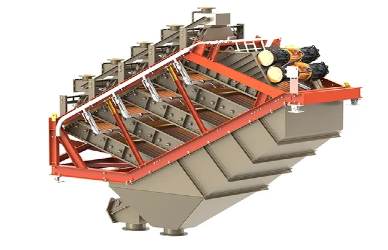
In a multi-deck layer stack vibrating fine screen, “high frequency” refers to a vibration mode with relatively high vibration speed and usually low amplitude, used to improve fine particle separation on the screen surface. It supports faster particle movement and more effective fine screening under suitable process conditions.
Compared with conventional screen motion (often lower frequency and larger amplitude for coarser materials), high-frequency low-amplitude motion creates quicker surface vibration and more frequent particle movement. This helps fine particles stratify faster and increases their chances of contacting screen apertures. Conventional motion focuses more on conveying and bulk movement, while high-frequency motion focuses more on fine separation efficiency.
High-frequency vibration is widely used in fine screening because fine particles need more precise and efficient presentation to screen openings. Faster vibration improves stratification and supports more consistent classification. In coarse screening, performance usually depends more on stronger conveying action and larger amplitude than on high-frequency effects.
High-frequency vibration helps the material bed re-arrange more quickly on the screen surface. As particles are repeatedly disturbed at a high rate, finer particles can move downward through the material layer more efficiently, while coarser particles tend to remain closer to the top. This faster stratification improves the screening conditions for fine particle classification.
Fine particle separation depends on how often fine particles reach and contact the screen openings. High-frequency motion increases the number of vibration cycles within a given time, which can improve particle presentation to the apertures. In practical terms, this means fine particles have more opportunities to pass through the screen when operating conditions are appropriate.
When feed conditions are reasonably stable—such as feed rate, particle size distribution, and moisture/slurry condition—high-frequency vibration can support more consistent separation behavior. This helps reduce fluctuations in screening performance and makes the process easier to control. However, stability still depends on proper feeding, deck loading, and screen media condition, not frequency alone.
Frequency and amplitude work together to influence screening performance. Frequency affects how often the screen surface moves, while amplitude affects how far it moves in each cycle. In fine screening, a higher-frequency, lower-amplitude motion is often used because it supports frequent particle movement and stratification without excessive throwing of material. If frequency, amplitude, and feed conditions are not matched, screening efficiency and separation stability may decrease.
In fine screening, vibration frequency is commonly expressed in Hz (cycles per second) or RPM (vibrations/rotations per minute), depending on the supplier’s design and drive system. Some manufacturers present frequency in Hz for technical vibration control, while others use RPM because it is easier to relate to motor or vibrator speed specifications.
Industry references often describe high-frequency screens in RPM ranges, but the exact values vary by machine type and application. For example, Astec lists high-frequency screen operation around 3,600–4,200 RPM for certain models, while broader industry references may cite wider ranges for high-frequency screens depending on design and use conditions.
Different suppliers may describe frequency differently because screen performance depends on more than one vibration parameter and because drive systems vary (such as electric or hydraulic vibrators, or other excitation methods). As a result, one supplier may emphasize RPM, another may list Hz, and others may focus on related parameters such as amplitude, stroke, or G-force to describe screening behavior.
For equipment selection, the supplier’s actual technical data sheet should always be the main reference for a specific model. Nominal “high-frequency” descriptions alone are not enough, because the suitable frequency range depends on machine structure, vibration mode, material condition, and process target. Checking the data sheet helps confirm how the model is specified and what operating range is recommended under real working conditions.
The suitable frequency depends on the material’s behavior on the screen surface, including density, shape, and flow characteristics. Particle size distribution also matters, especially when the feed contains many near-size particles that are harder to separate.
Wet and dry screening often require different operating strategies. In wet screening, slurry behavior and water distribution affect separation. In dry screening, moisture, particle adhesion, and flow behavior can change how particles stratify and pass through apertures.
Feed conditions strongly affect frequency suitability. Feed rate, slurry concentration (or moisture), and deck loading change bed thickness and particle movement. If loading is too high or feed fluctuates, screening stability may decline even at a suitable nominal frequency.
Screen media type and aperture size also influence the best operating frequency range. Different media respond differently to vibration and wear, while aperture size affects particle passage. Frequency should be considered together with media selection.
The right frequency also depends on the process goal. A setting suitable for fine classification may not be ideal for recovery-focused operation or dewatering support. Frequency should be selected as part of the overall process strategy.
Frequency alone cannot fully describe screening performance. Fine screening depends on frequency, amplitude/stroke, and vibration mode working together to control particle motion. In practice, effective screening comes from the right parameter combination, not frequency alone.
Actual results also depend on deck structure, feed distribution, and screen media. Uneven loading, poor deck utilization, or unsuitable media can reduce separation efficiency and stability, even if the nominal frequency looks suitable.
In real production, process integration and operating stability matter as much as frequency values. The screen must match upstream feed conditions and downstream process needs while running reliably over time. Final selection should be based on overall process fit, not frequency range alone.
Ask the supplier for the frequency range under actual operating load, not only no-load or nominal values. Real screening performance can change when the machine is running with material, so load-based data is more useful for evaluation.
Confirm whether the frequency is fixed or adjustable. This helps you understand how much flexibility the equipment has for different materials, feed conditions, or process changes over time.
Ask how frequency works together with amplitude (stroke) and vibration intensity. Frequency alone does not define screening behavior, so understanding these relationships helps you judge whether the machine is suitable for your fine screening target.
Provide your material and process information, then ask for a recommended operating window. A useful supplier recommendation should consider factors such as particle size distribution, wet or dry conditions, feed stability, and your process goal (classification, recovery, or dewatering support).
Not always. Higher frequency can improve fine particle stratification and particle presentation, but performance also depends on amplitude, feed condition, screen media, and deck loading. If these factors are not matched, a higher frequency may not improve results.
In many cases, yes. Wet and dry screening have different material behaviors, so the suitable frequency may differ. The best setting depends on slurry/moisture condition, feed stability, particle size distribution, and process target.
Frequency controls how often the screen moves, while amplitude controls how far it moves in each cycle. In fine screening, they must be matched to support particle stratification and stable separation. Frequency alone does not determine performance.
Besides the nominal frequency value, check whether the value is under load or no-load conditions, whether frequency is fixed or adjustable, the related amplitude/stroke range, vibration intensity, and any recommended operating window for your material and process goal.
In this context, “high frequency” refers to a high-speed vibration mode, typically paired with low amplitude, that is used to improve fine screening behavior and support more effective fine particle separation. Typical frequency values can vary by machine design, drive system, and the way suppliers present specifications, with some using Hz and others using RPM. For this reason, final equipment selection should always be based on actual operating conditions, material behavior, and process goals rather than frequency range alone.
