

close
Choose Your Site
Global
Social Media
Views: 0 Author: Site Editor Publish Time: 2026-02-25 Origin: Site


In modern industrial processing, fine screening plays a critical role in achieving stable product quality, improving downstream efficiency, and supporting better resource utilization across mineral processing, coal preparation, chemical processing, and other related industries. Whether the goal is particle size classification, recovery of valuable fine materials, or preparation for further separation and dewatering stages, accurate fine screening directly affects the performance of the entire production line. Compared with coarse screening, fine particle separation is more sensitive to operating conditions and equipment design, which is why conventional screening equipment often faces practical challenges in these applications. Common issues include limited screening efficiency for fine particles, larger installation footprints when higher capacity is required, and reduced operating stability under changing feed conditions. As production lines demand more precise classification, higher throughput, and better space utilization, the need for more specialized fine screening solutions has become increasingly important.
A High Frequency Multi Deck Layer Stack Vibrating Fine Screen is a specialized screening machine for efficient fine particle classification in industrial processing lines. It combines high-frequency vibration with a stacked multi-deck structure to improve fine screening performance and achieve effective separation in a compact installation space.
In screening applications, “High Frequency” refers to a vibration mode operating at a relatively high frequency. This helps accelerate material stratification on the screen surface and increases the chance of fine particles passing through screen apertures. It is especially useful where fine particle separation accuracy and screening efficiency are important.
“Multi Deck / Layer Stack” describes a design where multiple screening decks are arranged in a stacked configuration. Instead of one large screening surface, the equipment uses several layers to expand effective screening area vertically. This helps improve capacity and screening area utilization while reducing overall footprint.
A “Vibrating Fine Screen” uses controlled vibration to classify fine particles by size. Unlike screens mainly used for coarse separation, it is designed for fine screening tasks that require more precise particle size separation. This supports more consistent classification performance in processes where particle size control affects downstream operations.
The core function of this equipment is high-efficiency fine screening that supports overall process performance. It helps improve fine particle classification, increase throughput in limited space, and provide more stable feed conditions for downstream stages such as separation, recovery, or dewatering.
The screening process begins when material enters the machine through the feed inlet and is directed into a distribution system designed to spread the feed across the stacked screening decks. Uniform material distribution is essential because uneven feeding can cause some deck areas to become overloaded while others remain underutilized, reducing overall screening consistency. In a layer stack configuration, the feed distribution design helps ensure that each deck receives material in a controlled manner so the available screening area can be used more effectively.
Once the material reaches the screen surfaces, high-frequency vibration drives the separation process. This vibration mode helps the material bed stratify more quickly, allowing finer particles to move toward the screen surface and increasing their chances of passing through the apertures. In fine screening applications, this is especially important because small particles are more sensitive to bed thickness, feed condition, and motion pattern. By promoting faster particle presentation to the screen openings, high-frequency vibration supports more efficient and stable fine particle classification.
As material moves through the machine, screening takes place deck by deck in a stacked sequence. Each layer contributes to the overall classification process, and the combined deck arrangement increases the effective screening area within a compact footprint. Depending on the process design, the layers may work together to improve separation efficiency for a target size range or support staged classification within the same machine structure. This layer-by-layer approach helps improve capacity utilization while maintaining fine screening performance.
During operation, particles that pass through the screen apertures become the undersize fraction, while particles that remain on the screen surface become the oversize fraction. These streams are discharged through separate paths so they can be routed to the next process stage. In industrial processing lines, the undersize and oversize outputs are typically integrated into downstream operations such as further classification, recovery, dewatering, recirculation, or product handling. Clear discharge routing and stable separation results are important for maintaining overall process continuity and performance.
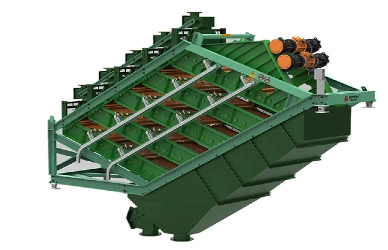
The screen frame and stacked deck structure form the mechanical foundation of the equipment. The frame supports the screening system, vibration components, and material flow loads during operation, while the stacked deck arrangement provides multiple screening layers within a compact vertical layout. This structure is important for maintaining alignment, supporting stable vibration transmission, and maximizing effective screening area without requiring excessive installation space.
Screen media are the working surfaces where particle size separation actually takes place. Depending on the application, material characteristics, and process goals, the equipment may use different screen media types such as polyurethane panels or wire mesh. The choice of screen media affects screening precision, wear resistance, service life, and maintenance frequency, so it should be matched to the operating conditions rather than selected only by aperture size.
The vibration exciter or motor system provides the driving force required to generate the screen motion used for fine particle separation. Its role is to deliver stable and controlled vibration so the screen surfaces can maintain consistent screening performance under continuous operation. Reliable vibration transmission is essential because changes in vibration behavior can affect material stratification, separation efficiency, and overall operating stability.
The feed distributor and discharge system manage how material enters, spreads across the decks, and exits the machine after classification. The feed distributor helps improve deck utilization by guiding material more evenly to the screening surfaces, while the discharge system separates and routes oversize and undersize streams to the next process stages. A well-designed feed and discharge arrangement supports smoother process integration, more consistent screening results, and easier operation management.
A major advantage of a multi deck layer stack fine screen is higher screening capacity in limited space. By stacking multiple decks vertically, the machine increases effective screening area without requiring a larger footprint. This is especially useful for plants that need higher throughput but have layout constraints.
When combined with high-frequency vibration, this screen design supports more efficient fine particle classification. The vibration helps improve material stratification and particle contact with screen apertures, increasing the chance of accurate separation. This is important in processes where fine classification quality affects downstream performance.
The equipment also offers good configuration flexibility. It can be adapted to different process needs through deck arrangement, screen media selection, and screening surface setup. This makes it suitable for a wide range of materials and classification targets.
Its compact structure, organized material flow, and stable screening performance make integration easier in industrial lines. It can connect effectively with upstream and downstream stages such as classification, recovery, dewatering, or recirculation, helping improve overall process coordination.
In mineral processing, this type of fine screen is used for fine particle classification and ore sizing. It helps improve particle size separation, which supports downstream processes such as grinding, separation, and recovery. Stable fine screening also helps maintain process consistency.
In coal preparation, it is often used for fine coal classification and recovery. It supports more stable separation of fine coal fractions and helps maintain screening performance under changing feed conditions. The high-frequency vibration and stacked deck design are useful for improving process continuity.
This equipment is also used in chemical, building materials, and non-metal applications that require fine particle separation. It is suitable for processes needing controlled classification, efficient space use, and flexible screen media selection based on material characteristics. Reliable fine screening helps support product quality and smoother downstream operations.
Often yes, because the stacked design offers a compact footprint. Feasibility still depends on site space, support structure, routing, access, and equipment integration.
Feed consistency strongly affects performance. Changes in feed rate, particle size, moisture, or slurry concentration can reduce stability, screening efficiency, and screen media life.
Common indicators include feed consistency, discharge behavior, deck loading balance, vibration condition, noise changes, and screen media wear. Regular tracking helps detect issues early.
Use stable feed control, suitable screen media, routine inspections, and preventive maintenance. This helps maintain screening quality while reducing unplanned downtime.
A high-frequency multi-deck layer stack vibrating fine screen is a specialized fine screening solution designed for efficient fine particle classification in modern industrial processing lines. By combining high-frequency vibration with a stacked multi-deck structure, it can improve space utilization, enhance fine screening efficiency, and support better compatibility with upstream and downstream process stages. For the best results, however, final equipment selection should always be based on actual operating conditions, material characteristics, and specific process goals.
