

close
Choose Your Site
Global
Social Media
Views: 0 Author: Site Editor Publish Time: 2026-03-04 Origin: Site


Buyers often compare a high-frequency multi-deck layer stack fine screen with a conventional vibrating screen because both are used for particle separation, but they are designed for different screening goals and operating conditions. Choosing the right screen type can directly affect classification quality, throughput, and even plant layout, especially when fine particle separation accuracy and space utilization are important. For this reason, the “difference” between the two should not be judged by a single parameter such as frequency or deck count alone, but by the actual application, including material characteristics, target cut size, process requirements, and installation constraints.
The first major difference is the screening purpose and the particle size range each machine is typically designed to handle. A high-frequency multi-deck layer stack fine screen is mainly used for fine particle classification, where separation accuracy and stable cut performance are important. In contrast, a conventional vibrating screen is more often used for general screening or coarser tasks, such as scalping, sizing, and bulk material separation, where the process focus is often on throughput and material handling rather than fine classification precision.
High-frequency stack screens are commonly chosen for fine separations because their vibration characteristics and stacked deck structure are designed to improve fine particle stratification and screening efficiency. The combination of high-frequency motion and multiple screening layers helps increase the opportunity for fine particles to contact screen apertures, which supports more effective classification in fine screening applications. This makes them especially suitable for processes where fine classification quality directly affects downstream recovery, separation performance, or product consistency.
Conventional vibrating screens are often used for scalping, sizing, and bulk separation because they are generally well suited to handling larger particle sizes and broader material flow conditions. In many plants, they offer a practical and widely used solution for screening duties where ultra-fine separation is not the main objective. Their application is common in stages that require pre-screening, capacity-focused sizing, or general separation before more specialized fine screening equipment is considered.
Another key difference is vibration behavior and motion style. High-frequency stack fine screens typically use high-frequency, low-amplitude motion, while conventional vibrating screens more commonly use lower-frequency, larger-amplitude motion. These two motion patterns are not simply different settings of the same concept—they are generally designed to support different screening tasks, material behaviors, and separation goals in industrial processing.
High-frequency, low-amplitude motion creates more frequent particle movement on the screen surface, which helps fine particles stratify and contact screen apertures more often. This can improve fine particle presentation and support more efficient fine classification under suitable feed conditions. In contrast, lower-frequency, larger-amplitude motion usually provides stronger conveying action and bulk material movement across the screen surface, which is often more suitable for coarser screening duties where material transport and general separation are the main priorities.
Because motion style directly affects how particles move, stratify, and pass through screen openings, it also changes separation behavior and application suitability. A motion pattern that works well for coarse sizing may not deliver stable results in fine classification, and vice versa. In practice, the preferred motion style depends on the material size range, process target, feed condition, and the level of separation precision required by the production line.
A high-frequency multi-deck layer stack fine screen uses a stacked deck structure to expand screening area vertically. Instead of relying mainly on a larger horizontal machine body, it adds multiple screening layers within one compact system. This design helps increase effective screening area and supports higher processing capacity in applications where fine screening performance and space efficiency are both important.
Conventional vibrating screens are commonly built in single-deck or double-deck layouts, with screening area expanded more often by increasing screen length and width. This can work well for many general screening tasks, but it usually requires more horizontal installation space when higher capacity is needed. In plants with layout constraints, this footprint requirement can become an important selection factor.
In space-limited plants, the comparison is often about capacity per footprint, not only total capacity. A multi-deck layer stack design can offer more screening area in a smaller floor space, which may improve layout efficiency for fine screening applications. Conventional screens may still be effective for broader or coarser duties, but when floor space is limited and fine classification is the priority, stacked deck designs are often considered more space-efficient.
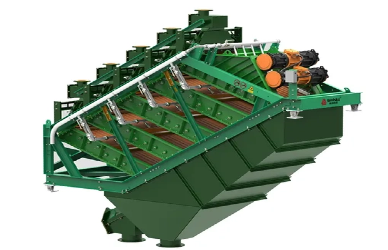
High-frequency screening can improve fine particle efficiency because it promotes faster stratification and more frequent particle movement on the screen surface. This helps fine particles move closer to the screen media and increases their chances of contacting the apertures, which is critical for fine separation performance.
Conventional vibrating screens can perform well in many general screening duties, but they may face limitations in fine classification tasks. Their motion style is often better suited to conveying and bulk separation, and under fine screening conditions they may provide less effective particle presentation to apertures, especially when separation precision is important.
Actual performance does not depend on screen type alone. Feed conditions such as particle size distribution, feed rate, and moisture/slurry condition can strongly affect screening efficiency and stability. Screen media selection also matters because aperture size, media type, and wear condition influence both separation quality and long-term operating consistency.
High-frequency multi-deck layer stack fine screens are commonly used in applications where fine particle classification is a key process objective, such as mineral processing, coal preparation, and other fine material separation duties. They are often selected when the process requires more precise fine screening, better space utilization, and stable separation performance to support downstream stages like recovery, classification, or dewatering.
Conventional vibrating screens remain a strong choice in many plants, especially for scalping, coarse sizing, and general bulk separation tasks. They are often more suitable when the process focus is on handling larger particles, moving high volumes of material, or performing broader screening duties where ultra-fine classification is not the main requirement. In these cases, a conventional screen can provide practical and effective performance.
The best choice depends on how the screen fits into the overall process line. Upstream feed conditions (such as particle size distribution, feed stability, and moisture/slurry condition) and downstream process goals (such as recovery efficiency, product size control, or dewatering support) directly influence screen selection. In practice, the screen should be chosen based on total process compatibility, not only on equipment type or vibration style.
In many cases, a high-frequency multi-deck layer stack fine screen is easier to consider for retrofit when floor space is limited, because its stacked design can provide more effective screening area within a smaller footprint. However, retrofit feasibility still depends on structural support, feed/discharge routing, maintenance access, and integration with the existing process line.
Sometimes, yes. Performance may improve through adjustments such as feed control, screen media selection, deck loading management, and operating condition optimization. However, if the process requires higher fine classification precision or better capacity-per-footprint, a high-frequency fine screen may still be the more suitable long-term solution.
When moving to high-frequency fine screening, screen media selection usually becomes more sensitive to fine separation targets, aperture accuracy, wear behavior, and material flow conditions. In other words, media is selected not only for durability, but also for how it supports fine particle presentation, stable classification, and maintenance planning.
Useful data typically includes particle size distribution, target cut size, feed rate, moisture/slurry condition, material variability, required product quality, and available installation space. Test results that show actual separation performance under realistic operating conditions are especially valuable for making the right choice.
The difference between a high-frequency multi-deck layer stack fine screen and a conventional vibrating screen is not only structural, but also functional and closely related to process requirements. High-frequency multi-deck stack screens are specialized for fine screening performance, more precise classification, and better space efficiency, especially in applications where fine particle separation quality has a direct impact on downstream results. Conventional vibrating screens, however, remain highly valuable for broader screening duties, coarse sizing, and general bulk material separation, and they continue to be a practical choice in many industrial processing lines depending on the material and process objective.
